







36V Lithium Battery Manufacturer

Custom 36V Lithium Battery Packs for E-Bikes, Power Tools, Robotics & Industrial Equipment

High-performance 36V lithium battery packs engineered for electric mobility, professional power tools, robotics, AGVs, floor equipment, material handling, lawn equipment, and OEM applications.

Nuranu Battery designs and manufactures custom 36V lithium battery packs for equipment that requires higher power, compact energy storage, reliable discharge performance, and application-specific battery integration.

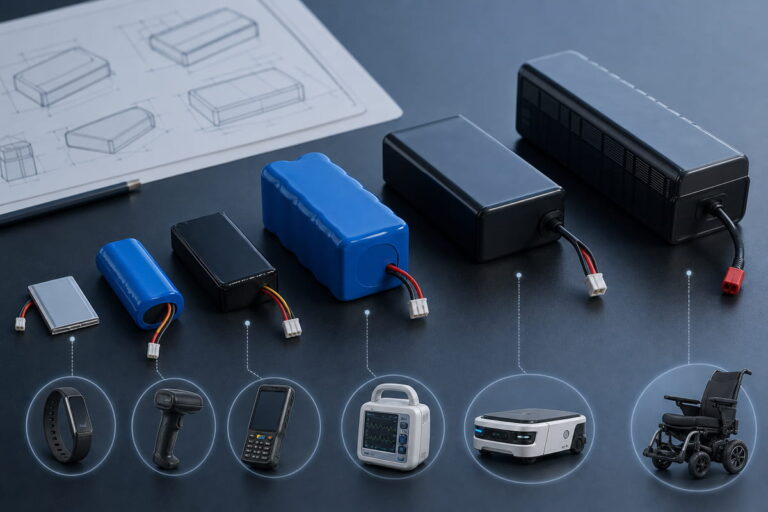
Choose from lithium-ion/NMC and other suitable lithium battery technologies, with custom: battery capacity, cell configuration, discharge current, BMS, battery enclosure, connector, communication interface, charging system and mechanical dimensions.

From compact 36V 10Ah battery packs to high-capacity 36V 50Ah and 100Ah systems, we can develop the battery around your equipment and performance requirements.

36V Lithium Battery Solutions for High-Power Applications

A 36V lithium battery is commonly used where a higher-voltage battery platform is needed for electric mobility, professional equipment, automation, and industrial machinery.

Compared with lower-voltage battery systems, a 36V platform can support higher system power while helping manage current requirements.

For example:

Power (W) = Voltage (V) × Current (A)

For the same power requirement, increasing system voltage can reduce the current required by the system.

This makes 36V-class battery systems attractive for applications such as:

  • E-bikes
  • Electric motorcycles
  • Scooters
  • Cordless power tools
  • Industrial robots
  • AMRs
  • AGVs
  • Floor scrubbers
  • Electric forklifts
  • Material handling equipment
  • Commercial lawn equipment

The correct battery still depends on the motor, controller, load profile, required runtime, charging system, and mechanical constraints.

36V Lithium Battery Solutions for High-Power Applications

36V Lithium Battery Specifications

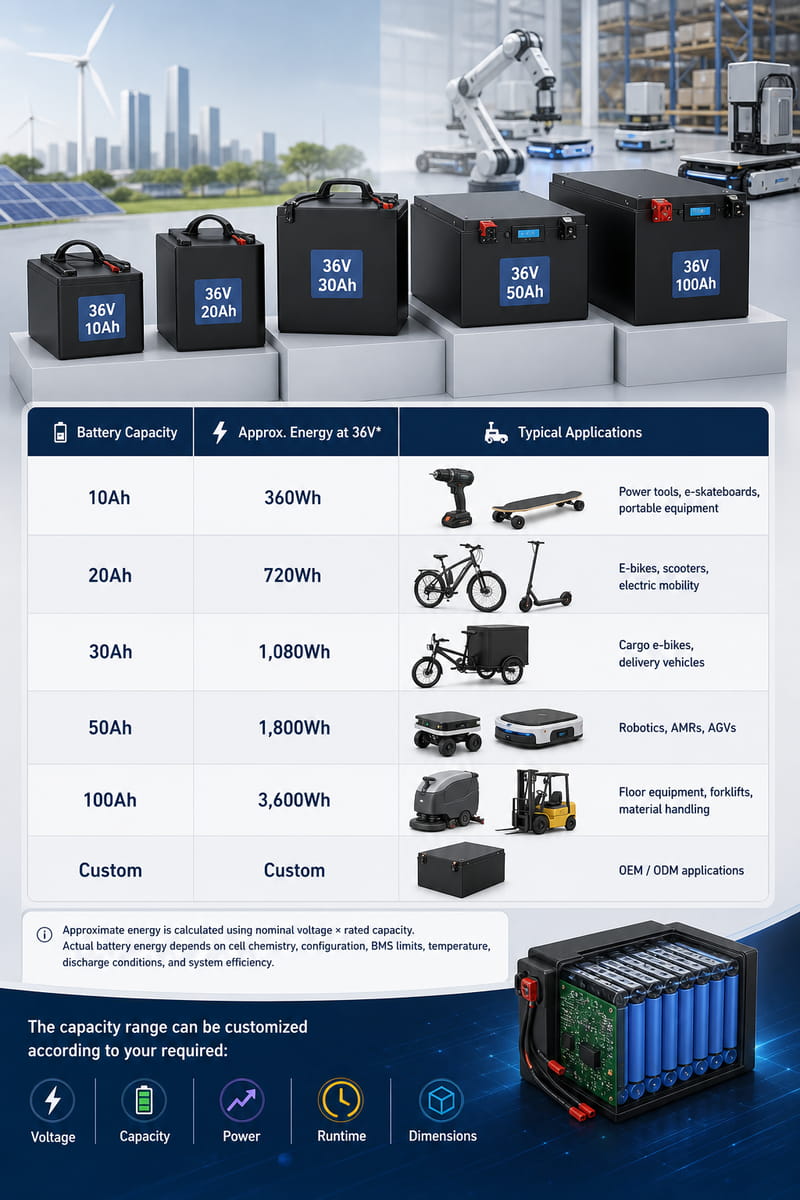
Nuranu can develop 36V-class lithium battery packs across different capacities and discharge requirements.

Battery CapacityApprox. Energy at 36V*Typical Applications
10Ah360WhPower tools, e-skateboards, portable equipment
20Ah720WhE-bikes, scooters, electric mobility
30Ah1,080WhCargo e-bikes, delivery vehicles
50Ah1,800WhRobotics, AMRs, AGVs
100Ah3,600WhFloor equipment, forklifts, material handling
CustomCustomOEM / ODM applications
  • Approximate energy is calculated using nominal voltage × rated capacity. Actual battery energy depends on cell chemistry, configuration, BMS limits, temperature, discharge conditions, and system efficiency.

The capacity range can be customized according to your required:

Voltage + Capacity + Power + Runtime + Dimensions

36V Lithium Battery Specifications

What Does 36V Mean in a Lithium Battery?

36V Is a System Voltage Class

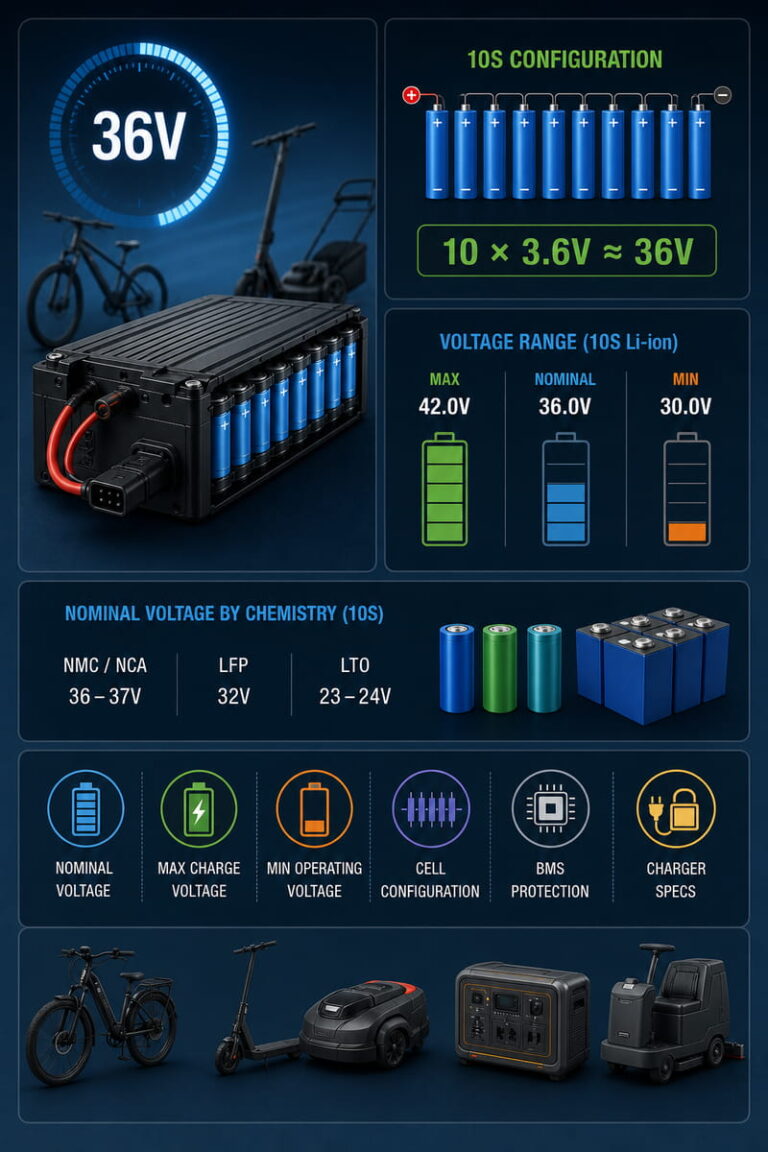
“36V lithium battery” usually describes a battery platform intended for a 36V-class electrical system.

The actual nominal voltage depends on the battery chemistry and cell configuration.

For example, a common lithium-ion configuration for a 36V-class battery uses 10 cells in series (10S).

With lithium-ion cells having a nominal voltage around 3.6–3.7V:

10 × 3.6V ≈ 36V

This is why 36V lithium-ion batteries are often described as 10S battery packs.

However, the exact voltage range depends on the selected cell chemistry and charging specifications.

For OEM applications, the battery should therefore be specified by:

  • Nominal voltage
  • Maximum charging voltage
  • Minimum operating voltage
  • Cell configuration
  • BMS cutoff parameters
  • Charger specification

rather than simply the “36V” label.

What Does 36V Mean in a Lithium Battery

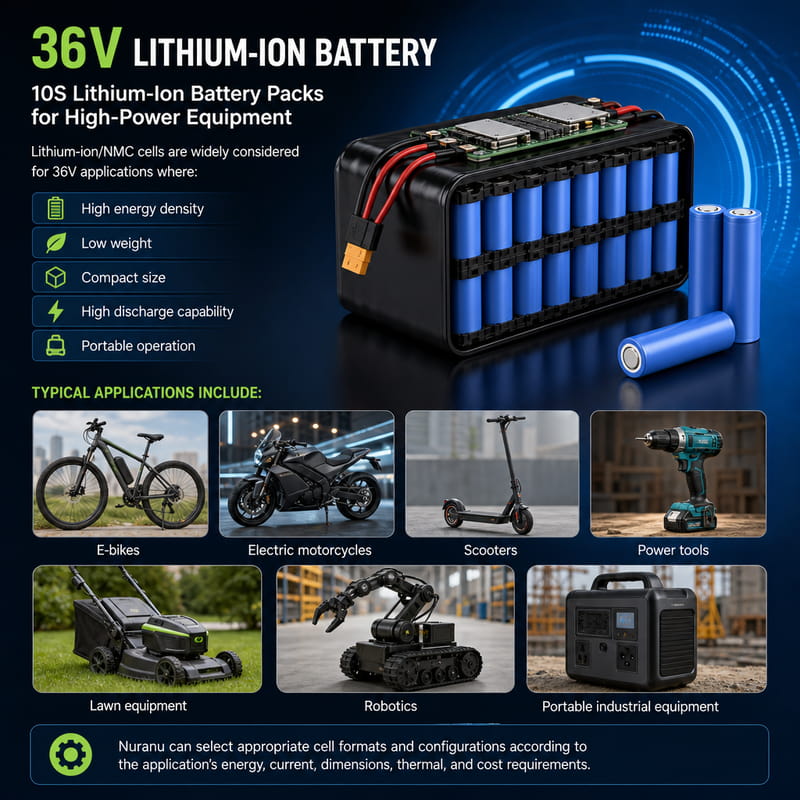
36V Lithium-Ion Battery

10S Lithium-Ion Battery Packs for High-Power Equipment

Lithium-ion/NMC cells are widely considered for 36V applications where:

  • High energy density
  • Low weight
  • Compact size
  • High discharge capability
  • Portable operation

are important.

Typical applications include:

  • E-bikes
  • Electric motorcycles
  • Scooters
  • Power tools
  • Lawn equipment
  • Robotics
  • Portable industrial equipment

Nuranu can select appropriate cell formats and configurations according to the application’s energy, current, dimensions, thermal, and cost requirements.

36V Lithium-Ion Battery

36V LiFePO4 Battery

36V-Class LiFePO4 Battery Solutions

LiFePO4 can also be considered for 36V-class applications where deep-cycle performance, thermal stability, and long-term operating requirements are important.

However, a LiFePO4 battery designed for a 36V-class system does not necessarily use the same series configuration as a 36V lithium-ion battery.

The cell chemistry determines the required series configuration.

For this reason, the battery manufacturer should evaluate:

Cell Chemistry → Series Configuration → Voltage Range → Charger → BMS

rather than simply replacing one lithium chemistry with another.

Potential applications include:

  • Industrial equipment
  • Floor-cleaning machines
  • Material handling
  • Solar systems
  • Robotics
  • Utility vehicles
  • Backup power
36V LiFePO4 Battery

Custom 36V Lithium Battery for Different Applications

Custom 24V Lithium Battery for E-Bikes

E-Bikes

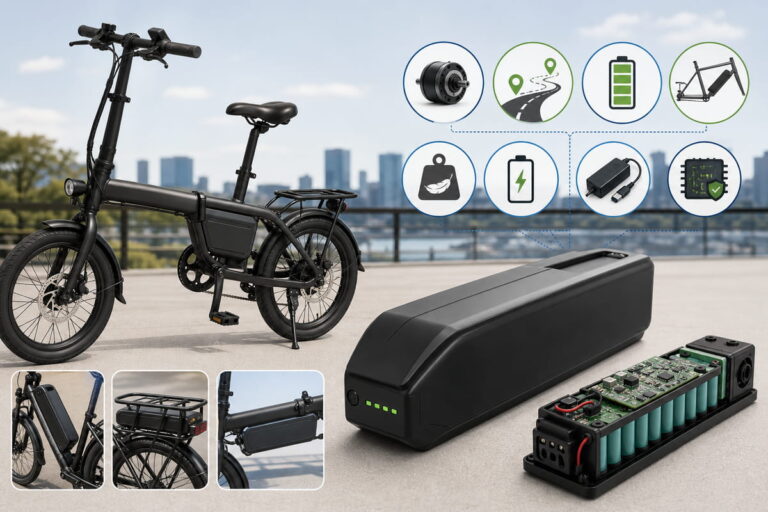
Custom 36V e-bike battery packs for electric bicycles and light mobility systems, tailored to motor and controller requirements, range, capacity, peak current, size, weight, and charging needs.

Custom Lithium Battery for Portable Equipment

Portable Equipment

A 36V 10Ah lithium battery provides about 360Wh of energy, making it suitable for compact power tools, electric skateboards, small mobility devices, portable equipment, lightweight robotics, and compact electric vehicles.
OEM Battery Pack Solutions for E-Bike & Electric Mobility

Electric Mobility

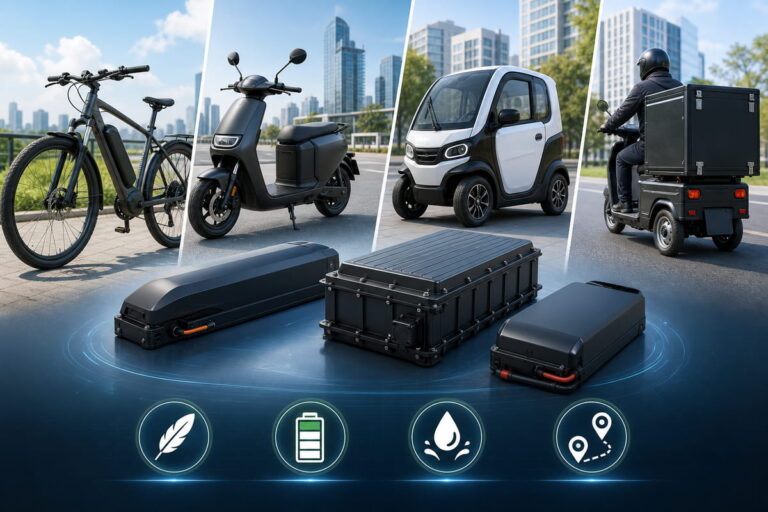
A 36V 20Ah lithium battery provides approximately 720Wh of energy and is commonly used in e-bikes, electric scooters, electric motorcycles, mobility equipment, delivery bicycles, and personal transport devices.
Custom Lithium Battery for Commercial Mobility

Commercial Mobility

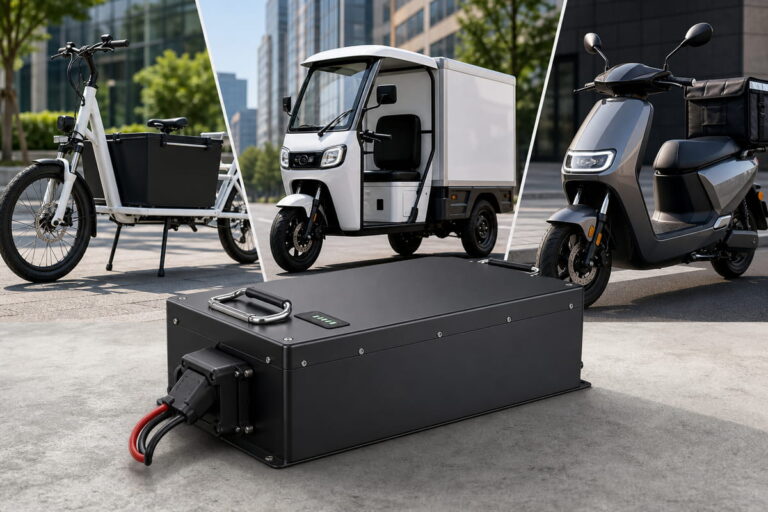
A 36V 30Ah lithium battery provides approximately 1,080Wh of energy, making it suitable for cargo e-bikes, delivery vehicles, commercial scooters, electric motorcycles.
Custom Battery Pack for Robotics & Automation

Robotics, AMRs and AGVs

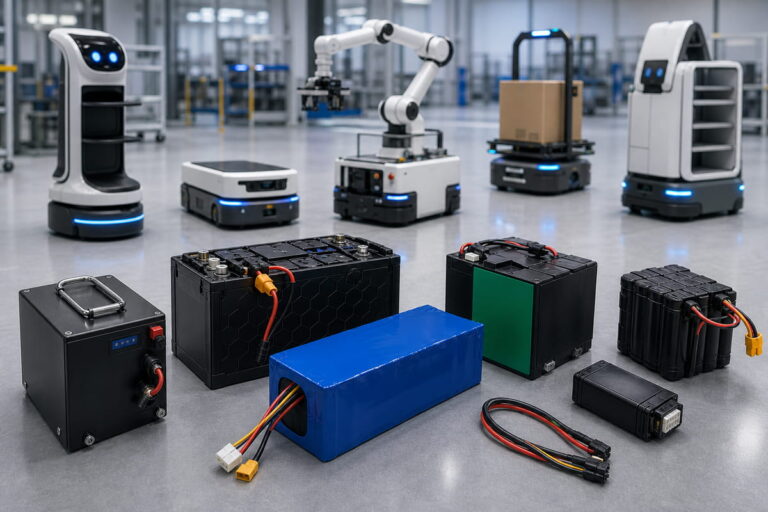
A 36V 50Ah lithium battery provides approximately 1,800Wh of energy and suits high-energy industrial applications such as robots, AMRs, AGVs, autonomous material-handling systems, mobile platforms.
Custom Lithium Battery for Industrial Equipment

Industrial Equipment

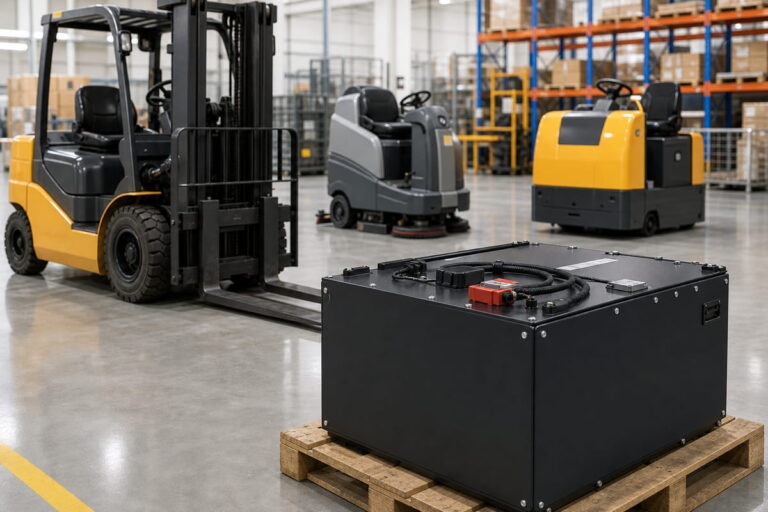
A 36V 100Ah lithium battery provides approximately 3,600Wh of energy for heavy-duty equipment such as electric forklifts, floor scrubbers, ride-on cleaning machines, material-handling systems, industrial vehicles, warehouse equipment.
Custom Lithium Battery for Electric Motorcycles

Electric Motorcycles

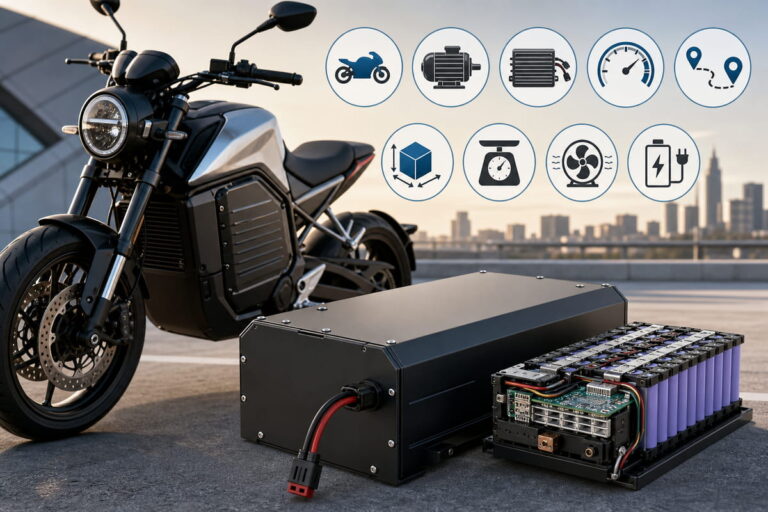
36V battery packs can be designed for selected electric motorcycles and light electric vehicles, with specifications tailored to motor power, controller current, acceleration, range, dimensions, weight balance, cooling, and charging time.

Custom Lithium Battery for Cordless Tools

Cordless Tools

Nuranu develops 36V high-discharge battery packs for professional cordless tools, including chainsaws, hedge trimmers, leaf blowers, concrete saws, demolition tools, drills, and commercial lawn equipment.
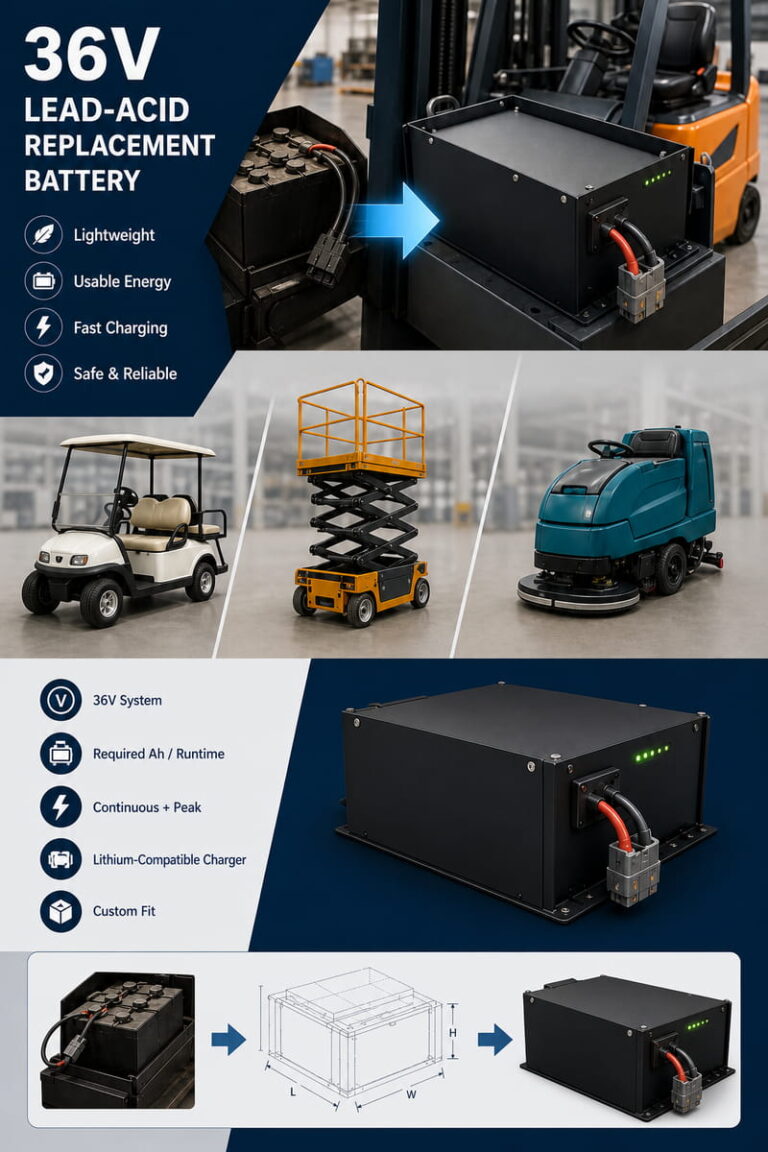
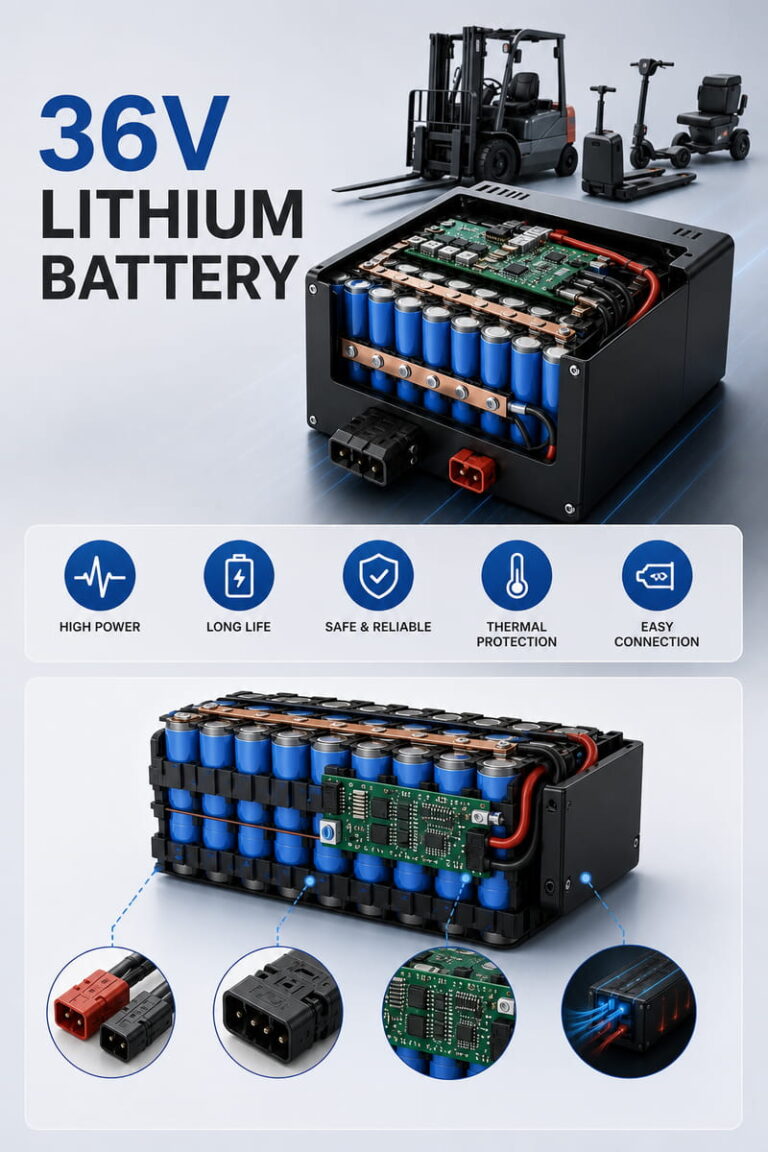
36V Lead-Acid Replacement Battery

Replace 36V Lead-Acid Systems with Lithium

Many industrial machines and electric vehicles were originally designed around lead-acid battery systems.

Many industrial machines and electric vehicles were originally designed around lead-acid battery systems.

A lithium replacement can offer advantages in areas such as:

  • Weight
  • Usable energy
  • Charging flexibility
  • Maintenance requirements
  • Packaging efficiency

However, a lead-acid replacement should never be selected only by matching the nominal voltage.

The following parameters must be evaluated:

ParameterRequired Check
Voltage36V-class system
CapacityRequired Ah / runtime
CurrentContinuous + peak
ChargerLithium-compatible charging profile
DimensionsBattery compartment
WeightVehicle/equipment requirements
BMSCurrent + protection parameters
CommunicationCAN / RS485 / other
EnvironmentTemperature, vibration, moisture
ConnectorPower + signal interface

Nuranu can use the existing battery as a reference for a custom replacement design.

36V Lead-Acid Replacement Battery

36V High-Discharge Lithium Battery

Battery Packs Designed for High Current Loads

High-power equipment requires more than a large Ah rating.

For example, two batteries may both be rated at 36V 20Ah, but their actual power capability can be very different depending on:

  • Cell chemistry
  • Cell model
  • Internal resistance
  • C-rate
  • Number of parallel cells
  • BMS current rating
  • Wiring
  • Connector
  • Thermal management

Nuranu can design 36V battery packs around both energy requirements and power requirements.

Key Parameters

  • Continuous discharge current
  • Peak discharge current
  • Motor startup current
  • Cell C-rate
  • BMS current rating
  • Connector current rating
  • Thermal conditions
36V High-Discharge Lithium Battery

36V Smart BMS

Intelligent Battery Management for Connected Equipment

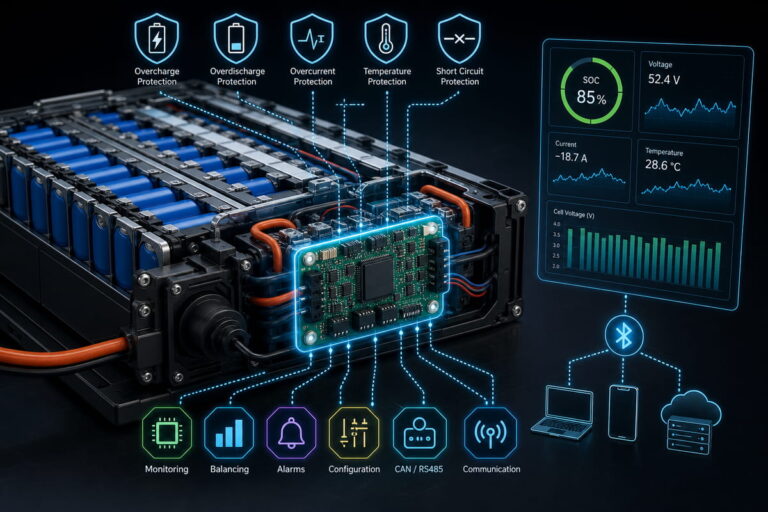
For professional and industrial applications, the BMS can provide more than basic protection.

Protection Functions

  • Overcharge
  • Over-discharge
  • Overcurrent
  • Short circuit
  • Over-temperature
  • Low-temperature
  • Cell imbalance

Monitoring Functions

  • Pack voltage
  • Cell voltage
  • Current
  • Temperature
  • SOC
  • SOH
  • Cycle count
  • Fault status

Communication

  • CAN
  • RS485
  • UART
  • Bluetooth

For AMRs, AGVs, robots, forklifts, and industrial machines, communication between the battery and host controller can be integrated into the battery architecture.

36V Smart BMS

36V Battery Energy Calculation

How Much Energy Does a 36V Battery Store?

A simple nominal energy calculation is:

Energy (Wh) = Voltage (V) × Capacity (Ah)

For a 36V-class battery:

CapacityApprox. Nominal Energy
10 Ah360 Wh
20 Ah720 Wh
30 Ah1,080 Wh
50 Ah1,800 Wh
100 Ah3,600 Wh

These values are nominal calculations.

Actual usable energy depends on:

  • Battery chemistry
  • Cell configuration
  • BMS cutoff settings
  • Discharge current
  • Temperature
  • System efficiency
  • Required reserve capacity
36V Battery Energy Calculation

36V Battery Runtime Calculation

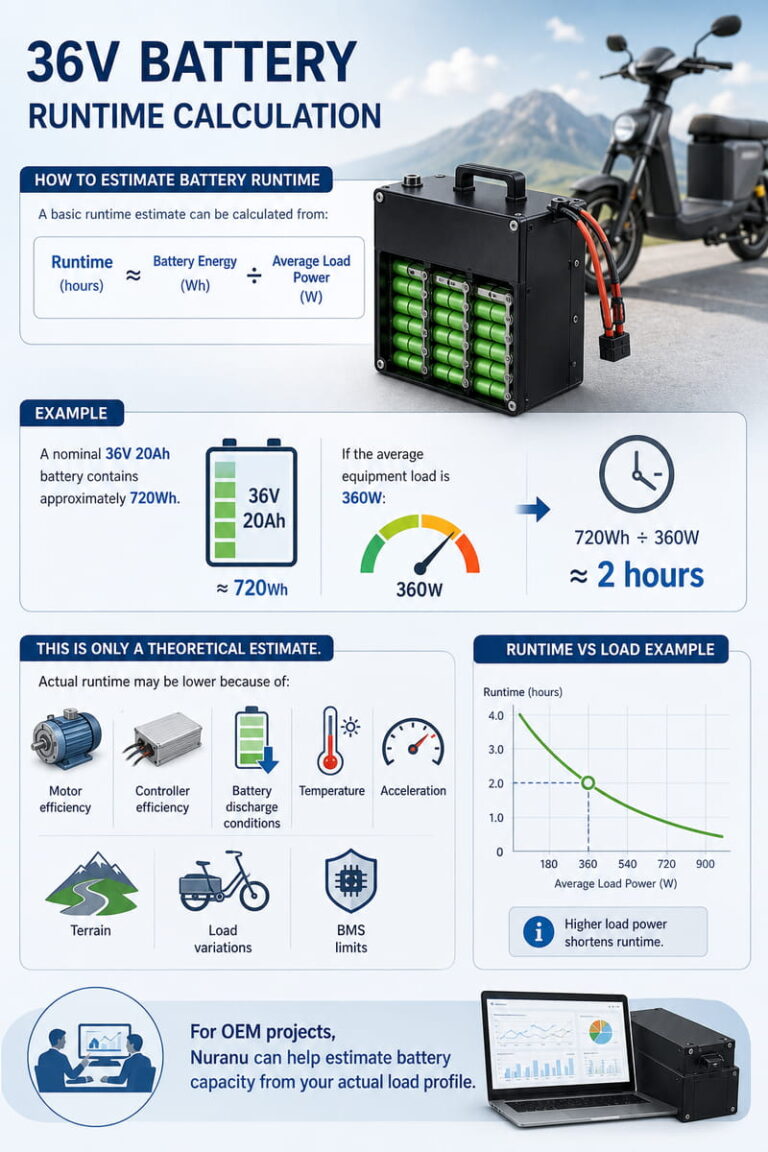
How to Estimate Battery Runtime

A basic runtime estimate can be calculated from:

Runtime (hours) ≈ Battery Energy (Wh) ÷ Average Load Power (W)

For example, a nominal 36V 20Ah battery contains approximately 720Wh.

If the average equipment load is 360W:

720Wh ÷ 360W ≈ 2 hours

This is only a theoretical estimate.

Actual runtime may be lower because of:

  • Motor efficiency
  • Controller efficiency
  • Battery discharge conditions
  • Temperature
  • Acceleration
  • Terrain
  • Load variations
  • BMS limits

For OEM projects, Nuranu can help estimate battery capacity from your actual load profile.

36V Battery Runtime Calculation

Custom 36V Battery Enclosure

Mechanical Design for OEM Integration

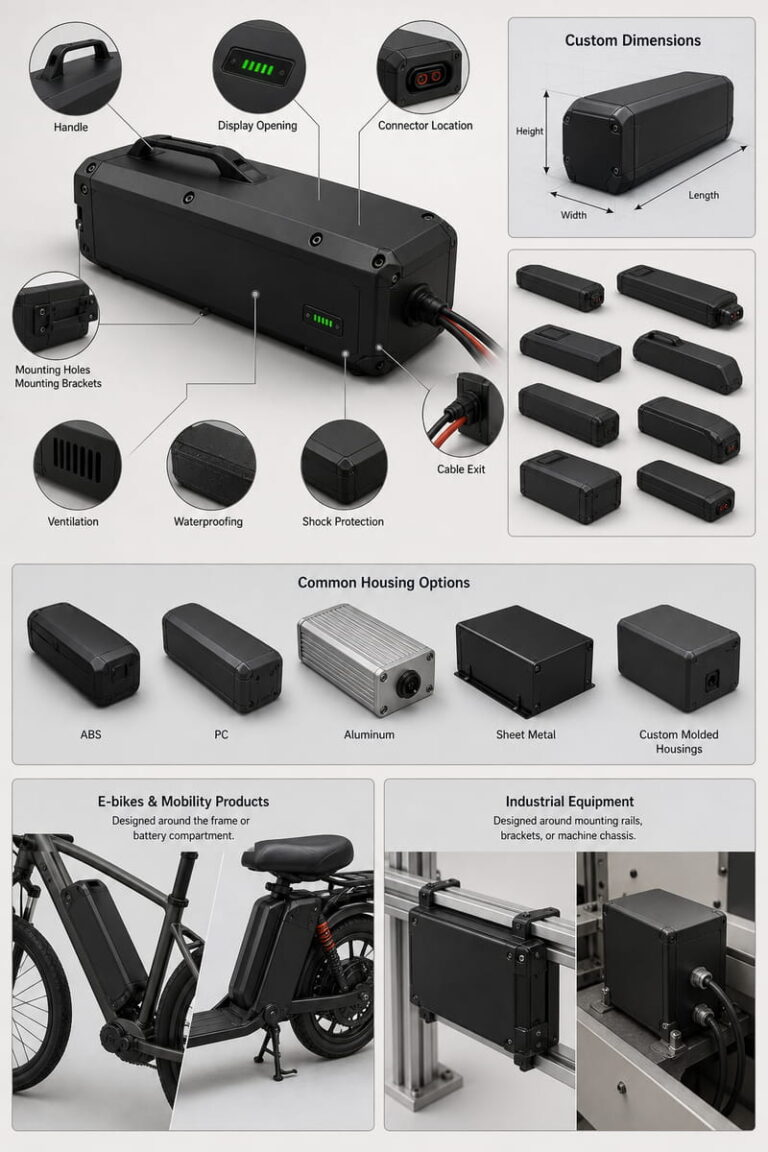
A 36V battery does not need to use a standard housing.

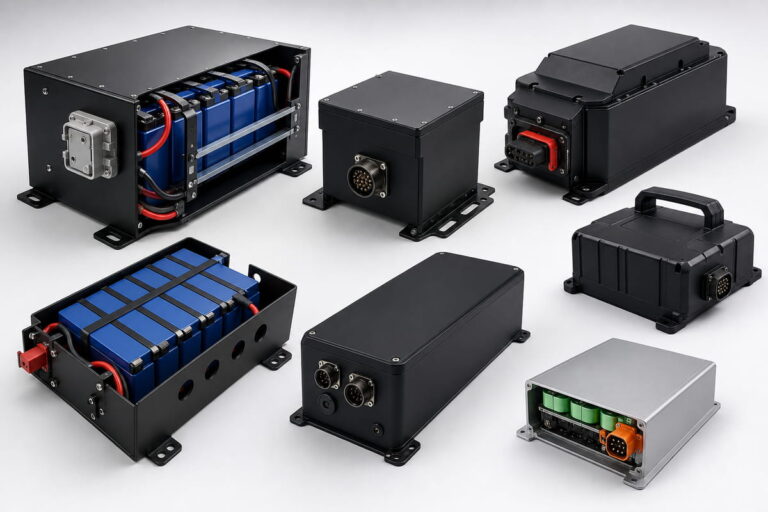
Nuranu can customize:

  • Length
  • Width
  • Height
  • Mounting holes
  • Mounting brackets
  • Handle
  • Connector location
  • Cable exit
  • Display opening
  • Ventilation
  • Waterproofing
  • Shock protection
  • Thermal management

Common housing options include:

  • ABS
  • PC
  • Aluminum
  • Sheet metal
  • Custom molded housings

For e-bikes and mobility products, the enclosure can be designed around the frame or battery compartment.

For industrial equipment, the housing can be designed around mounting rails, brackets, or machine chassis.

Custom 36V Battery Enclosure

Custom 36V Battery Connectors

Power and Communication Interfaces

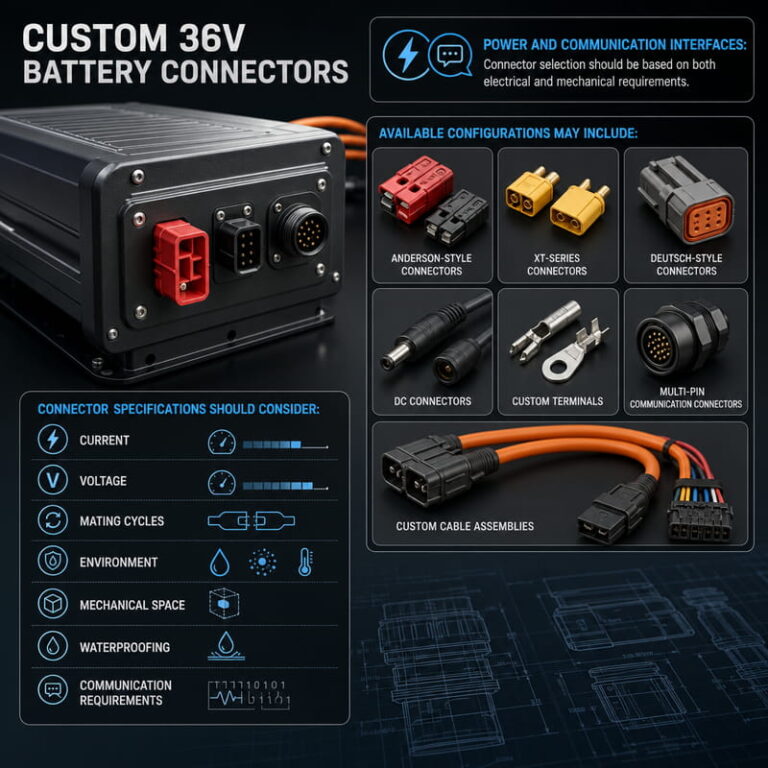
Connector selection should be based on both electrical and mechanical requirements.

Available configurations may include:

  • Anderson-style connectors
  • XT-series connectors
  • Deutsch-style connectors
  • DC connectors
  • Custom terminals
  • Multi-pin communication connectors
  • Custom cable assemblies

Connector specifications should consider:

  • Current
  • Voltage
  • Mating cycles
  • Environment
  • Mechanical space
  • Waterproofing
  • Communication requirements
Custom 36V Battery Connectors

Custom 36V Battery Charging

Charger and Battery Must Be Matched

The correct charger depends on:

  • Battery chemistry
  • Cell configuration
  • Maximum charging voltage
  • Charging current
  • BMS
  • Battery temperature
  • Required charging time

For high-power applications, fast charging should be evaluated together with:

  • Cell chemistry
  • Cell temperature
  • BMS limits
  • Charger capability
  • Expected daily duty cycle

For automated equipment such as AMRs and AGVs, the charging strategy can be integrated into the overall battery system design.

Custom 36V Battery Charging

Custom 36V Battery Development Process

From Battery Requirements to Mass Production

Step 1 — Application Analysis

We evaluate:

  • Equipment
  • Voltage
  • Capacity
  • Power
  • Current
  • Runtime
  • Dimensions
  • Charging
  • Environment
Custom 36V Battery Application Analysis

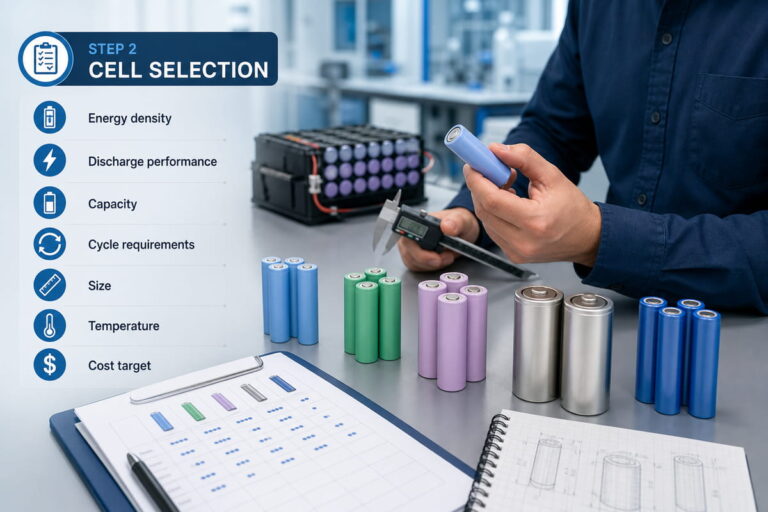
Step 2 — Cell Selection

Cells are selected according to:

  • Energy density
  • Discharge performance
  • Capacity
  • Cycle requirements
  • Size
  • Temperature
  • Cost target
Custom 36V Battery Cell Selection

Step 3 — Electrical Configuration

We determine:

  • Series configuration
  • Parallel configuration
  • Pack capacity
  • Maximum current
  • BMS requirements
Custom 36V Battery Electrical Configuration

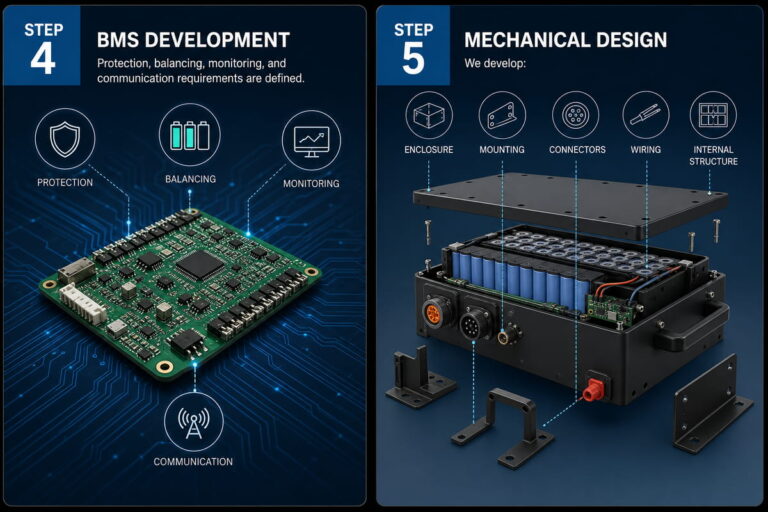
Step 4 — BMS Development

Protection, balancing, monitoring, and communication requirements are defined.

Step 5 — Mechanical Design

We develop:

  • Enclosure
  • Mounting
  • Connectors
  • Wiring
  • Internal structure
Custom 36V Battery BMS Development and Mechanical Design

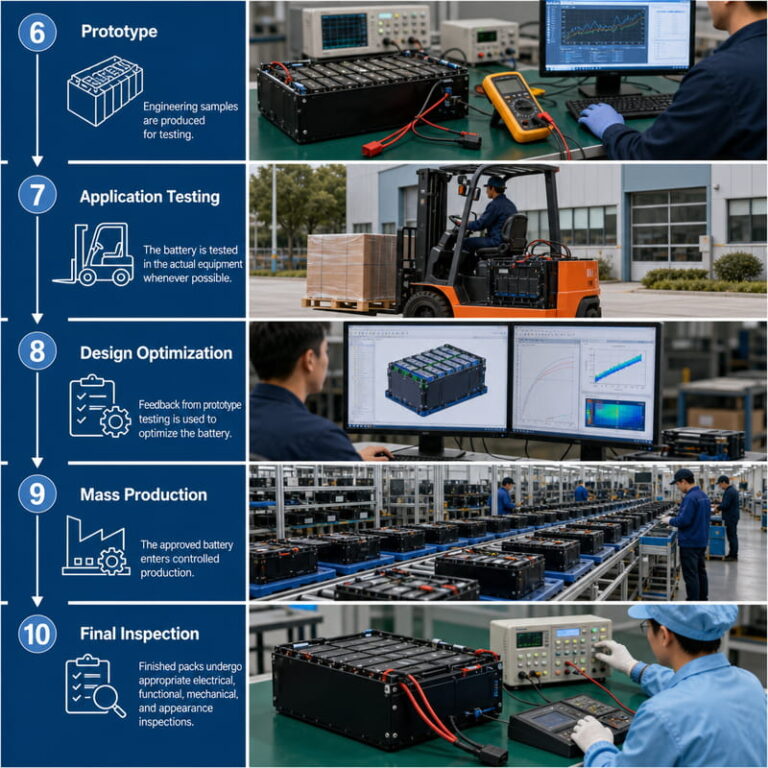
Step 6 — Prototype

Engineering samples are produced for testing.

Step 7 — Application Testing

The battery is tested in the actual equipment whenever possible.

Step 8 — Design Optimization

Feedback from prototype testing is used to optimize the battery.

Step 9 — Mass Production

The approved battery enters controlled production.

Step 10 — Final Inspection

Finished packs undergo appropriate electrical, functional, mechanical, and appearance inspections.

Custom 36V Battery Prototype, Application Testing, Design Optimization, Mass Production and Final Inspection

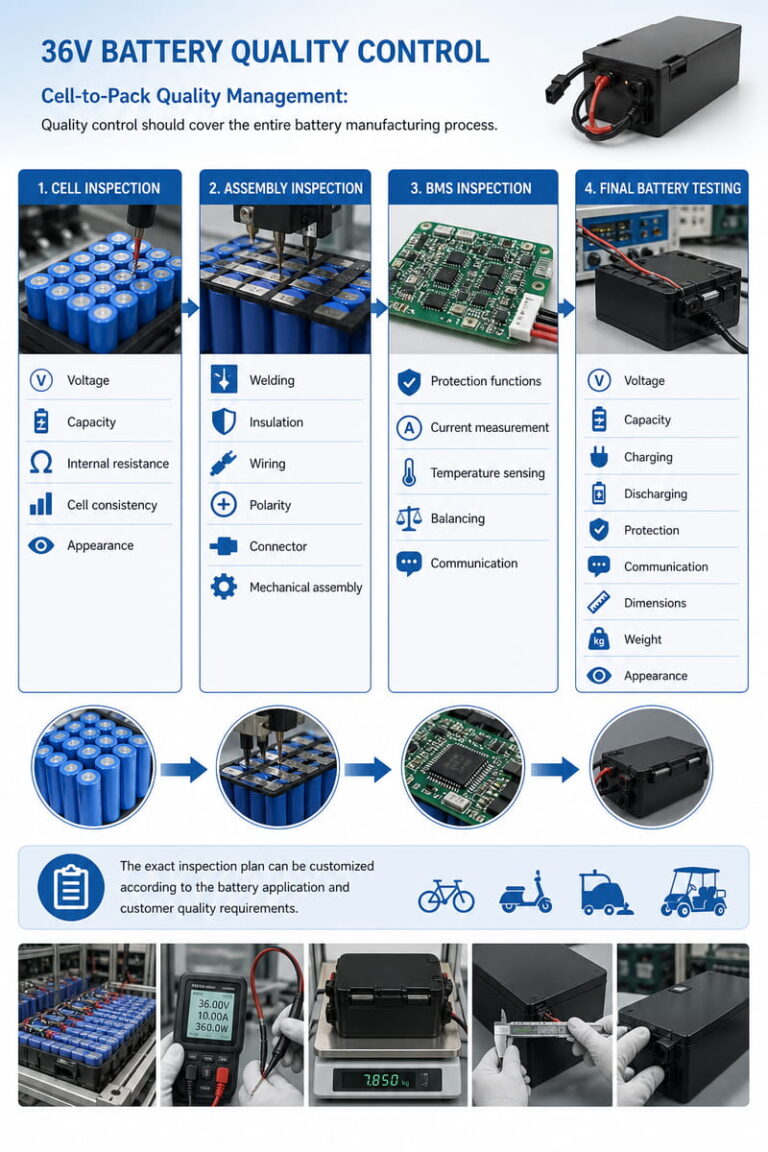
36V Battery Quality Control

Cell-to-Pack Quality Management

Quality control should cover the entire battery manufacturing process.

Cell Inspection

  • Voltage
  • Capacity
  • Internal resistance
  • Cell consistency
  • Appearance

Assembly Inspection

  • Welding
  • Insulation
  • Wiring
  • Polarity
  • Connector
  • Mechanical assembly

BMS Inspection

  • Protection functions
  • Current measurement
  • Temperature sensing
  • Balancing
  • Communication

Final Battery Testing

  • Voltage
  • Capacity
  • Charging
  • Discharging
  • Protection
  • Communication
  • Dimensions
  • Weight
  • Appearance

The exact inspection plan can be customized according to the battery application and customer quality requirements.

36V Battery Quality Control

36V Lithium Battery Certifications

Certification and compliance requirements depend on the battery chemistry, final configuration, application, and destination market.

Depending on the project, documentation or testing may include:

  • UN38.3
  • IEC 62133
  • CE
  • RoHS
  • MSDS
  • Transportation documentation
  • UL-related requirements

For OEM projects, certification requirements should be defined before final battery design because changes to the battery configuration can affect testing requirements.

36V Lithium Battery Certifications

OEM / ODM 36V Lithium Battery Manufacturer

Develop Your Battery Around Your Product

Nuranu supports both OEM and ODM battery projects.

OEM Battery Manufacturing

Provide your existing:

  • Battery specification
  • Drawing
  • Battery sample
  • Product requirements
  • BMS requirements
  • Enclosure design

We manufacture according to the agreed specifications.

ODM Battery Development

If you only have the equipment and performance requirements, we can help develop:

  • Cell selection
  • Cell configuration
  • Capacity
  • BMS
  • Enclosure
  • Connector
  • Wiring
  • Charging
  • Communication

This is particularly useful for companies developing new e-bikes, robotics, industrial equipment, power tools, or commercial machines.

OEM ODM 36V Lithium Battery Manufacturer

Why Choose Nuranu for 36V Lithium Batteries?

More Than a Standard Battery Supplier

Nuranu provides custom battery engineering from electrical design to production.

Engineering-Focused Manufacturing

Nuranu's 36V battery platform is designed for applications where power, reliability, integration, and customization matter.

High-Power Battery Design

Battery cells, BMS, wiring, and connectors can be selected according to your actual current requirements.

Custom Capacity

Choose the capacity required for your runtime and available installation space.

Application Engineering

Battery design can be matched to motors, controllers, charging systems, and mechanical structures.

OEM/ODM Support

Our current platform emphasizes custom voltage/capacity, BMFrom prototype to production, the battery can be developed as part of your product system.

How to Request a Custom 36V Lithium Battery

For an accurate quotation, please provide:

  1. Required voltage
  2. Capacity or required runtime
  3. Continuous current
  4. Peak current
  5. Motor/load power
  6. Battery dimensions
  7. Battery chemistry preference
  8. Connector
  9. Charger specification
  10. Operating temperature
  11. Communication requirements
  12. Application
  13. Estimated order quantity
  14. Target market
  15. Certification requirements

If you are replacing an existing battery, send:

Battery label + photos + dimensions + connector + equipment model

If you have CAD files or a technical drawing, these can further accelerate battery development.

How to Request a Custom 36V Lithium Battery

36V Lithium Battery FAQ

A 36V lithium battery is a rechargeable battery system designed for a 36V-class electrical platform. The actual nominal and operating voltage depends on the battery chemistry and cell configuration.

A common lithium-ion 36V battery uses a 10S configuration, meaning ten cells or cell groups are connected in series.

The exact configuration depends on the cell chemistry and nominal voltage.

A 36V 10Ah battery has approximately 360Wh of nominal energy based on voltage × capacity.

It can be used for compact high-power equipment, portable machines, electric skateboards, and other applications requiring a 36V-class battery.

A 36V 20Ah battery has approximately 720Wh of nominal energy. It is commonly considered for e-bikes, scooters, mobility equipment, and other electric transportation applications.

A 36V 50Ah battery provides approximately 1,800Wh of nominal energy. It can be suitable for higher-energy applications such as robotics, AMRs, AGVs, and industrial equipment.

Yes. Nuranu can develop 36V-class 100Ah battery systems for industrial equipment, floor scrubbers, forklifts, material handling, and other high-energy applications.

Yes. 36V is a common battery platform for e-bikes and light electric mobility applications.

The correct battery depends on motor power, controller current, desired range, dimensions, and charging requirements.

In suitable applications, yes.

However, charger compatibility, current requirements, dimensions, BMS configuration, and system voltage range must all be checked before replacement.

Yes. High-discharge 36V battery packs can be designed using cells and BMS components selected for the required continuous and peak current.

The final IP rating should be determined and tested according to the actual enclosure design.

Yes. A smart BMS can be configured with CAN, RS485, UART, Bluetooth, or other communication interfaces depending on the host equipment.

Yes. Battery dimensions, mounting points, connector position, cable routing, housing material, and environmental protection can all be customized.

The most important information is:

Voltage + Capacity + Current + Power + Runtime + Dimensions + Application + Charger + Connector

An existing battery sample, drawing, or photographs can also be used as the starting point for a replacement or custom battery project.

Need a Custom 36V Lithium Battery?

Tell us your voltage, capacity, current, dimensions, and application. Our engineers can help you select the appropriate cell chemistry, cell configuration, BMS, enclosure, connector, and charging solution.

Contact Form
Scroll to Top

Ask a Quote

Contact Form