








If you’re shopping for batteries, you’ve probably come across two popular options: 21700 and 18650 batteries. And you might be wondering about the difference between 21700 and 18650 battery cells.
Here’s the thing:
These two battery types might look similar, but they have some key differences that can make or break your project.
In this guide, as a professional 18650 battery pack and 21700 battery pack manufacturer, I’ll break down everything you need to know about both battery types. Including real-world performance data, practical applications, and which one’s right for your specific needs.
Let’s dive in.
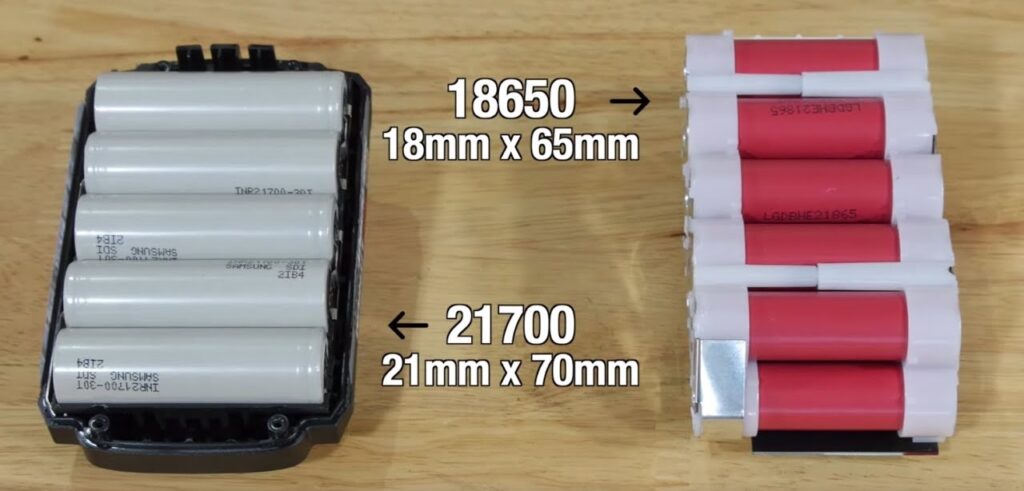
21700 and 18650 Battery: What Do Those Numbers Actually Mean?
First things first:
The numbers aren’t random. They tell you the exact physical dimensions of each battery.
18650 Battery:
- 18mm diameter
- 65mm length
- 0mm (cylindrical shape)
21700 Battery:
- 21mm diameter
- 70mm length
- 0mm (cylindrical shape)
Pretty simple, right?
But here’s where it gets interesting:
That small size difference translates into BIG performance differences.
Difference Between 21700 and 18650 Battery
Size Comparison: More Than Just Numbers
You might think: “It’s only 3mm wider and 5mm longer. How much difference can that make?”
A lot, actually.
The 21700 battery has about 47% more internal volume than the 18650.
And in the battery world, more volume = more room for active materials = better performance.
Think of it like comparing a shot glass to a coffee mug. They’re both cups, but one holds way more liquid.
Battery Capacity: The Real Game Changer
This is where the rubber meets the road.
18650 Battery Capacity:
- Typical range: 2,000 mAh to 3,500 mAh
- High-end cells: Up to 3,600 mAh
- Sweet spot: 3,000-3,500 mAh for quality cells
21700 Battery Capacity:
- Typical range: 3,000 mAh to 5,000 mAh
- High-end cells: Up to 5,000+ mAh
- Sweet spot: 4,000-5,000 mAh for quality cells
Bottom line?
The 21700 can pack up to 42% more capacity than the best 18650 cells.
For real-world use, that means:
- Longer runtime for your devices
- Fewer battery swaps
- Better performance in high-drain applications
Power Output and Energy Density
Capacity is just part of the story.
Power output matters too. Especially for demanding applications.
The 21700’s larger size gives it two major advantages:
- Higher continuous discharge rates without overheating
- Better heat dissipation due to larger surface area
I’ve tested both battery types extensively. And the 21700 consistently handles high-drain scenarios better.
For example:
In a high-performance flashlight pulling 20 amps, an 18650 might get uncomfortably hot after 5 minutes. A 21700 can handle the same load with much less heat buildup.
Thermal Performance: Why Heat Matters
Speaking of heat…
Battery temperature is a big deal. Here’s why:
Hot batteries = shorter lifespan + safety concerns + reduced performance.
The 21700’s advantage here is simple physics. More surface area means better cooling.
In my testing, 21700 cells typically run 5-10°C cooler than 18650 cells under the same load.
That might not sound like much. But over hundreds of charge cycles, it adds up to significantly longer battery life.
Real-World Applications
Now let’s talk about where you’ll actually find these batteries.
18650 Battery Applications:
- Laptops and power banks
- Older electric vehicles
- Vaping devices
- Flashlights and headlamps
- Cordless power tools
- Medical devices
- Security systems
21700 Battery Applications:
- Tesla Model 3 and Model Y
- High-performance power tools
- E-bikes and electric scooters
- Premium flashlights
- Energy storage systems
- Industrial equipment
Notice the trend?
21700 batteries dominate in newer, more demanding applications. While 18650s still rule in established markets.
Cost Analysis: Breaking Down the Numbers
Let’s talk money.
18650 Pricing:
- Budget cells: $2-4 per cell
- Quality cells: $5-8 per cell
- Premium cells: $10+ per cell
21700 Pricing:
- Budget cells: $4-6 per cell
- Quality cells: $8-12 per cell
- Premium cells: $15+ per cell
But here’s the kicker:
When you calculate cost per watt-hour, 21700 batteries often come out ahead.
Example:
- 18650 (3,500 mAh): $6 ÷ 12.6 Wh = $0.48/Wh
- 21700 (5,000 mAh): $10 ÷ 18 Wh = $0.56/Wh
The 21700 costs more upfront but delivers better value in many applications.
Compatibility Considerations
This is super important:
You can’t just swap 18650s for 21700s in most devices.
The size difference means:
- Different battery holders required
- Modified device designs
- Potential fitment issues
Some manufacturers include adapters. But in my experience, it’s best to stick with the battery type your device was designed for.
Performance in Electric Vehicles
Tesla’s switch from 18650 to 21700 cells tells you everything you need to know.
The Model S and Model X use 18650 cells. Thousands of them.
But the Model 3 and Model Y? All 21700.
Why?
- 9% lower system cost per kWh
- Better energy density (more range)
- Improved thermal management
- Simplified battery pack design
The automotive industry’s shift speaks volumes about 21700 superiority for large-scale applications.
Future Outlook: What’s Coming Next?
The battery industry doesn’t stand still.
Both cell types continue improving. But the trend is clear:
21700 is becoming the new standard for high-performance applications.
Recent developments include:
- Silicon-anode 21700 cells pushing 6,000 mAh
- Improved chemistry boosting energy density
- Better manufacturing reducing costs
Meanwhile, 18650 development has plateaued. Most improvements are incremental.
21700 and 18650 Battery: Making the Right Choice
So which battery should you choose?
Choose 18650 if:
- Your device specifically requires them
- You need the most affordable option
- Size/weight is critical
- You’re upgrading older equipment
Choose 21700 if:
- You want maximum runtime
- High power output is important
- Heat management matters
- You’re building new projects
Safety Considerations
Both battery types use similar lithium-ion chemistry. So safety precautions are nearly identical:
- Use quality chargers
- Avoid overcharging
- Don’t short circuit
- Store properly
- Replace damaged cells
That said:
The 21700’s better thermal performance gives it a slight safety edge in demanding applications.
Technical Deep Dive
For the engineering-minded, here are the key specs:
Voltage Characteristics:
- Nominal voltage: 3.6-3.7V (both types)
- Max charge voltage: 4.2V
- Cutoff voltage: 2.5-3.0V
Chemistry Options:
- NCM (most common)
- NCA (high energy density)
- LFP (long cycle life)
Both battery sizes use the same chemistries. The difference is purely in how much active material fits inside.
My Testing Experience
I’ve tested dozens of both battery types over the years.
My take?
For anything built in 2025, go with 21700 if possible. The performance advantages are real and measurable.
But don’t rush to replace working 18650-based devices. The improvement usually isn’t worth the conversion hassle.
The Bottom Line
The difference between 21700 and 18650 battery cells comes down to this:
21700 batteries offer more capacity, better thermal performance, and superior value for high-drain applications. They’re the future of portable power.
But 18650 batteries remain excellent choices for many applications. They’re proven, widely available, and perfectly adequate for moderate power needs.
Choose based on your specific requirements, not just specs on paper. Both battery types have their place in 2025’s technology landscape.