








Searching for the easiest ways to check the mAh capacity of an 18650 lithium-ion battery? You’ve come to the right place.
In this detailed guide, as a professional 18650 battery packs manufacturer, I’ll walk you through several methods to accurately measure the capacity of 18650 batteries so you know precisely how much juice they pack.
Whether you obtained these cylindrical cells from old laptop batteries or directly purchased them, verifying their capacity is essential before using them in projects. After all, you want batteries that can supply enough runtime at the required load currents.
Let’s get started!
Why Measure 18650 Battery Capacity
First, let’s look at why checking mAh capacity is crucial for 18650 batteries.
As the name suggests, 18650 refers to the dimensions – 18mm diameter and 65mm height. It’s the most popular lithium-ion battery size used in vapes, flashlights, power banks, and even electric vehicles.
However, an 18650 cell labeled as 3000 mAh may not always deliver that much capacity in real life.
There could be discrepancies due to the following reasons:
- Cell degradation – During usage over time, lithium-ion cells lose their ability to hold charge resulting in reduced capacity.
- Misleading labels – Some unethical sellers exaggerate the marked capacity values to attract more sales. You may encounter fake clones with ridiculously high capacity labels.
- Manufacturing defects – Even brand new cells may sometimes leave the factory with capacity defects or internal short circuits that prevent their optimal performance.
So measuring capacity is the only way to reveal the battery’s true runtime. This helps assess their health to decide whether they’re still usable or ready for recycling.
Moreover, accurate mAh readings allow proper load planning in battery-powered equipment. Insufficient current output from cells with poor capacity will lead to early voltage cut-off and unexpected shutdowns.
Now that you know why checking capacity matters, let’s discuss the testing options…
How to Check the mAh of 18650 Battery
There are several ways to determine the true mAh or runtime of 18650 lithium-ion cells.
Here are some popular testing methods:
Use a Battery Analyzer
The quickest and most precise option is to employ a dedicated 18650 battery capacity checker or analyzer.
These specialty devices have features to safely discharge cells at specific load currents and log voltage measurements. By calculating discharge duration and current draw, they display highly accurate mAh readings.
Battery analyzers range from simple single-slot testers that show capacity values to advanced models with tabulated databases for multiple cells.
High-end capacity checkers also reveal additional metrics like internal resistance that indicate a cell’s state of health (SoH). So investing in them is worth considering if you routinely deal with multiple 18650 cells.
Reliable options include SkyRC MC3000 and Cadex C7400ER, with the ability to test hundreds of different lithium-based batteries.
Use a Basic Charger
Several 18650 battery chargers meant for vaping also display remaining capacity while juicing up cells.
These offer a ballpark indication but should not be relied on for precision testing as the values can sometimes be off. Charging rate inaccuracies and cell chemistry differences play a role here.
Still, getting an approximate idea about capacity may be good enough for reusable household batteries. Just don’t expect very accurate or consistent readings compared to dedicated analyzers.
Look for chargers supporting the 18650 battery size, such as those from Liitokala and Xtar.
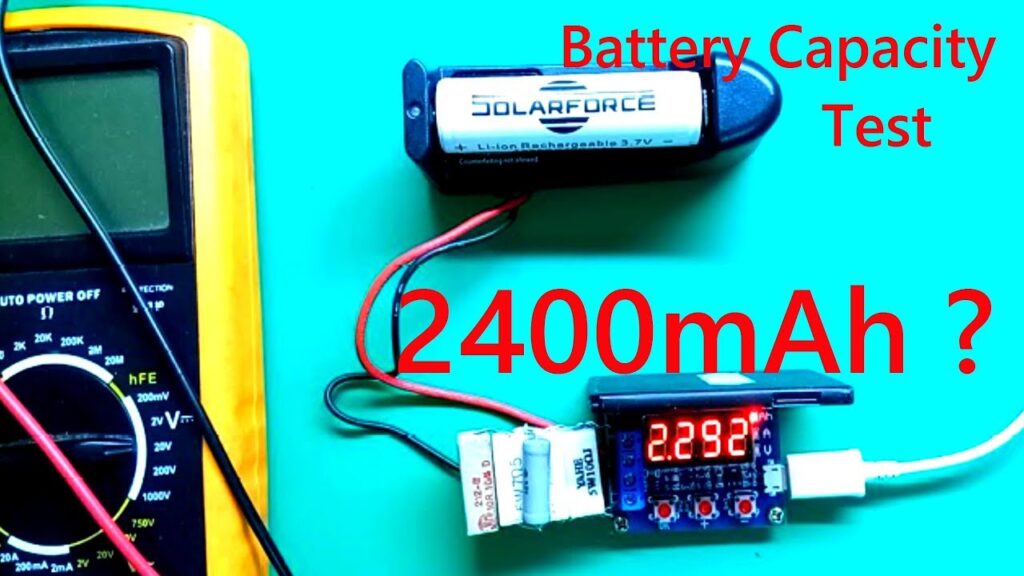
DIY Load Test
For a DIY approach, you’ll need –
- Multimeter
- Power resistor
- Stopwatch
First, fully charge the 18650 cell and note the starting voltage (around 4.2V). Next, connect a suitable power resistor like 10 ohms 2 watts to it.
Now start the timer and check the cell voltage periodically as it reduces gradually. When the cell voltage drops to your minimum threshold which is 3.0-3.2V for 18650, note down the elapsed time.
Finally, divide the discharge duration in hours by the power rating of the resistor (10Ω here). The result gives you the actual tested battery capacity in Ah units that you multiply by 1000 to convert to mAh readings.
This basic method gives good accuracy with minimal tools but tests only one cell at a time. Use thicker connecting wires and avoid short circuits for safety.
CC-CV Charging
Companies manufacturing 18650 packs use a technique called Constant Current, Constant Voltage (CC-CV) charging to estimate cell capacity before assembly.
They first completely discharge the cells to the cut-off threshold which is 2.5V for lithium-ion chemistry. The cells are then charged to 4.2V at a fixed current of say 0.5C (1600mA for a ~3000 mAh cell).
As soon as charging voltage hits the 4.2V ceiling, charging current starts reducing while the voltage remains at 4.2V. The charger transitions into CV mode. When the current drops below 3% of nominal capacity (~90mA for our 3000 mAh example cell), charging stops.
The instrument tracks overall mAh supplied back into the discharged cell which gives its realistic capacity. Advanced algorithms may also account for efficiency losses during the charging process.
So companies performing battery pack production have access to the true capacity data for the chosen 18650 cells.
Ways to Determine if 18650 is original
With worryingly high numbers of fake lithium-ion cells out there, here are some warning signs if you suspect an 18650 battery may not be genuine:
- Abnormally heavy or light weight cell
- No manufacturer branding and model number printed on the casing
- Very low or ridiculously high rated capacity (>3500 mAh presently)
- Deformed/damaged shell or plastic wrap
- Weird protuberances or markings
- Excess heat emission
- Leaking electrolyte emissions
Always insist on cells from reputable brands like Samsung, Sony, Panasonic, Sanyo or LG if the power application demands reliably safe batteries. Check online for authorized dealers that sell genuine cells instead of cheaper knock-offs which tend to fail unpredictably.
Conclusion
Determining actual mAh capacity of 18650 lithium-ion cells before integration into battery packs or equipment is crucial. It reveals their true runtime performance at the required discharge currents.
Investing in a dedicated 18650 battery testing analyzer gives precise quantitative results with richest data. But DIY load rundown methods can also work in a pinch.
Watch out for counterfeit cells with unrealistic capacity labels or build quality issues that could be safety hazards. Stick to reputable manufacturers like Samsung, Sony and Panasonic for best reliability.
With this guide equipping you about methods to check 18650 battery capacity, testing their available mAh for any power application becomes much easier. Stay safe as you determine true cell runtime!